Showing posts with label humanities. Show all posts

Monday, March 28, 2011

This post is going to be short and sweet, given my relative lack of sleep today, and my working at the day job today despite the fact that this is supposed to be my day off. Of course, short and sweet naturally precludes more cannibalism.

Instead, I'll share why I didn't get enough sleep: I was working on my novel. And by "this post is going to be short and sweet," I mean I'm not going to write much that hasn't already been written. I am, however, going to share an excerpt from my book, as I finished the first major revision of chapter one last night.

Max After Earth is a tale of unchecked human expansion and greed, where man's inventions try to save him, in spite of himself. More information about the book's progression, and more opportunities to read excerpts, can be had at the book's Facebook page.

Without further ado, I give you this excerpt from chapter one:

It is the 37th of August, 2032, a day that scientists have warned: Apophis will, undeniably, hit the Earth. As the reports go, the force of one hundred nuclear bombs will be unleashed when the massive asteroid strikes. How many will the impact itself kill? If those same reports are to be trusted, then perhaps only thirty million. Assuming there are thirty million people left to kill. Far more likely, an object of that mass entering the atmosphere will ignite the methane cloud, burning up the Earth’s oxygen, and suffocating everyone; those at the highest elevations systematically succumbing moments before those below them, as though the hand of Death itself were literally coming down the mountainside. Barring such a grandiose and instantaneous of extinctions, there are always tsunamis, toxic gasses, and, depending on where it hits, nuclear meltdown, crumbling global infrastructure, or further upset to the world’s already unstable food economy. It isn’t a question of whether everyone will die—that much is known—it is only a question of how. Read more...

Comments

Monday, November 22, 2010

I'm not dead, as the title clearly states. This is an update to let you know what I've been up to, and why the long silence (hint: it has to do with the novel I've been writing). New posts will follow in December.                  


Photo by malky

I haven't written in ages, and I really didn't want to leave you hanging. I had a lot of posts that I planned on writing over the summer, but they just never happened. I'm working for the man now, an ungodly forty hours a week. But, I'm also working on the first draft of my first novel: Max After Earth. In my story, the Earth has been so ravished by human activity that when an asteroid (perhaps you've heard of Apophis?) threatens all life on Earth, scientists flee the planet rather than try to find a way to stop the calamity, no longer finding the Earth worth saving. I've written about 190 pages so far, and I'm starting to wrap things up. There's still a lot of editing that needs to be done. No, seriously a lot of editing. But, I'm that much closer to realizing my dream of writing and publishing a book, and it deals with a lot of my favorite topics, including environmental issues, forest gardening, human relationships, and technology. It's interesting to see all of these different thought processes come together in one work of fiction.

To those of you maintaining your own blogs, I'm apologize that I haven't been around to read your, no doubt fantastic, work. Maybe when my book is off to the publishers I'll be able to take a break and do some catching up.

I hope you'll continue to follow me on my journey. Any money that I'm able to make off of my book will be seed money for starting a forest garden of my own, a forest garden which I will be able to use to teach other's forest gardening (both in person and through this blog) and that's something I really look forward to.

Until my next update, which could be some time in coming given the current work load, take care.

Comments

Wednesday, May 12, 2010

Since this blog is about me writing as much as it is anything environmental--that just happens to be what I hone my writing on--I thought I'd share news about my world of academia and what's been keeping me away from the blog.         


From my advisor:

"Some lines in here are publishable, Matt. You're smart, have a good sense for telling the story, and aren't afraid to confront the monster. All the makings of a true memoirist."

That might not seem like much unless you're a writer. When you're a writer, you have to learn to compensate for the fact that your mentors will ration compliments to A) keep them from going to your head and turning you into a monster, and B) make sure you never settle for second best. As writers, we have to pretend that those compliments aren't actually 500,000% better than they seem for those very same reasons. In a sense, a good chunk of writing is learning to lie to yourself until your lies are true... or something. I'm actually just caffeinated and exhausted, so none of this really makes sense. If I'm lucky I'll manage to sound wisely ambiguous, so when you don't get it you'll think you just haven't thought about it hard enough.

Anyways...

Photo by Josep Ma. Rosell 
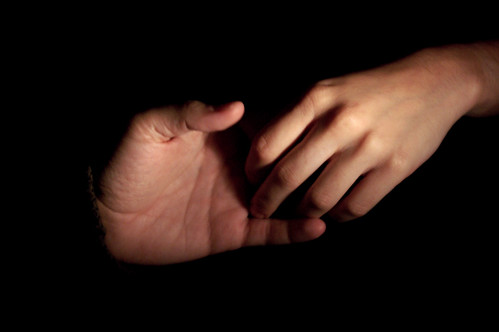
I don't think I've shared with you, my readers, what my non-environmental work is. This project in particular is a memoir, if you hadn't gathered from the quote. I've been doing research on touch in America, and especially the tendency for Americans to conflate touch and affection with sexuality. A kiss can't just be a kiss, it has to signify romantic/sexual interest. Compared to other industrialized nations, in this regard, the U.S. seems to be trailing (just like we are in so many other areas.) That doesn't mean there isn't a problem at all in other countries, but the research I've done suggests that we're the worst, and because I'm U.S.American, I can contribute my personal experiences to the discussion of this research. So, that's what my work does. It blends my personal experiences and the experiences of people I know with the research I've been doing in order to appeal both to people who want a compelling story, but also those that want objective facts and a scientific basis.

One piece of interesting research involved a survey of teenage mothers. Most of those teens admitted that they didn't want sex, but rather they wanted love and affection, to feel cared for and desired. This deficit of love and affection, the study suggested, stems from the fact that American parents are made to feel incestuous, or like pedophiles, if they try to be affectionate with their children once they reach puberty and mature sexually. It becomes inappropriate for adults to touch their children in more than just a simple hug or the like. Sex and relationships are a way for teens to fill that void.

And I said that this is completely unrelated to my environmental work, but that's not entirely true. I'm a systems thinker, and it's my "job" to work out how seemingly disparate things go together. It seems self-evident to me that how we interact with others shapes and defines out quality of life and level of happiness. Happy people make better decisions. People with strong relationships tend to rely on material things for their utility rather than as a replacement for human affection, and so are less wasteful (taking a public bus rather than a Ferrari.). Even as a kid growing up, my family had stronger ties with my neighbors than I do now, or than any people that I know have with their own neighbors. As certain resources become more scarce, it will be easy to compete with each other, trying to get more than our fair share, instead of cooperating with each other to preserve that resource. We're a splintered society, and as much as it might be ironic for a blogger to say so, technologies like the internet are part of that problem (though they can just as easily be part of the solution.) We can reach out to someone we barely know halfway across the world, but we never even say "hi" to our neighbors. What if that simple greeting is all it took to make the world a better place?

That, and a good night's sleep... which I hope to get right now. And then I face my last day of classes for the foreseeable future...

Wish me luck, and I'll do the same for you in all of  your endeavors.

Comments

Monday, March 15, 2010

Art inspires us to act. Some of us, at least. Some art is so well-blended with science that it's hard to tell where one ends and the other begins. Don't know what I mean? Ecovention contains some of the best examples of this unique blend (though it appears to be out of print).

The art in Ecovention is functional in a very beautiful way. You can see plants change colors as they react to, and filter out, heavy metals in the soil. Places that shouldn't be alive are made that way by these thoughtful artists.

But sometimes what art "does" is less about the art itself, and more about how it makes us feel, and what it makes us do.


Take Pete Dungey's pothole gardens for instance. In subject, it's a far cry from a forest garden. But, in spirit, it's exactly the same thing. It's a concession to let nature do what it will, and allowing nature to benefit us, rather than forcing it to do so. It is a concession that we are not apart from nature, but rather, a part of nature.

Plants are patient. They pre-date animal life by millions of years. Long after we're gone, they'll still be here, as you'll no doubt realize if you've ever tried to remove a well-adapted invasive weed (Himalayan blackberry in my case).

When we are gone, those plants which we've chased into the shadows will reemerge. Their roots will break up our roads, crumble our bridges, and topple our skyscrapers. Plants have no archeologists. Plants don't care about that little blip in Earth's history called Homo sapiens. They will just go on living.

If this sounds like the voice of loss, it is not.

Plants are so unassuming that it can be awe-inspiring to step back and realize how well they thrive in spite of us. Rebellious, they will not be told "no." We cut them back, but they return, branches outstretched toward the sun, toward warmth. They bend with the wind. They bend with the sun. Forever bending, if slowly, but not breaking. They have time. They are in no hurry to get where they are going. Where they are going? Destination: life.

To move at a plant's speed would not be a major inconvenience, though we might think it so. A plant can bend 180 degrees in a single day, chasing after a light. The plant doesn't know where the light is coming from tomorrow. The plant doesn't know if the light is coming tomorrow. The plant simply follows the light each day that it does come and it is strengthened all the more for it. And if the light doesn't come the plant won't make any fuss about its passing. It was nourished by the dead, and now it will be among them, nourishing whatever future takes root. And why must we look any further than today? If we do not have water and nutrients and sunshine, we seek them out, and when the sun sets we will be content.

But we won't be.

Can we ever be?

We are torn between our pasts--where we survived when natured nurtured us--and our futures--where we have the knowledge and power to bend nature to our will, regardless of what the costs might be.

All of this is to say that there really is very little that separates a writer and a biologist. We're all just blips.  And if either one of us got everything we wanted, we would likely find our species to be unbearably off-kilter.

But you wouldn't know we were so similar by the reactions we get.

My studies took me toward the humanities, despite my great appreciation for the natural world (or, perhaps, because of it). Because I have made that decision, I am not "allowed" to do science. "Leave science for the scientists," they will say.

"If I have to call my science 'art,' then so be it."

But if I have to call my science art in order to have it respected, then we take too lightly the words of one great scientist:
Imagination is more important than knowledge. For knowledge is limited to all we now know and understand, while imagination embraces the entire world, and all there ever will be to know and understand. ~Albert Einstein
We mustn't forget just how much science has followed from science fiction. Or, for that matter, how much science has been born in the bosom of philosophic discourse.

Art and philosophy are the parents of human endeavor. They are the inquisitive mind on which science is built.

As a writer, I might have to stand back and let the scientists take credit for their often egocentrically named theories. But, silent as the plants, I can take pride in knowing that my reaching for the sun, my putting things into words, is exactly what will decide the direction of science long after I'm gone. And just as plants will outlive us, as our species declines, being able to share stories with our loved ones will prove more important than the gadgets we use to do so.

Comments